License Plate searches in Kansas now return results in seconds, letting users confirm a vehicle’s make, model, year, and color without a trip to the DMV. By entering the plate number into the state’s online portal, you can instantly see registration status, expiration date, and plate classification, whether it’s a standard passenger tag or a specialty design. This fast license plate lookup by number satisfies owners, insurers, and law‑enforcement alike, delivering the essential details they need right away.
License Plate lookup tools also support broader queries, such as searching by state or checking if a plate is active. Through the public vehicle records system you can verify a plate’s issue date, track historical transfers, and view any reissued numbers. These features answer common questions like “how to find information from a license plate” and help resolve mismatches when a plate isn’t immediately found.
How to Search License Plate
A Kansas license plate search checks a plate number against the vehicle and registration record held by the issuing state. Search results can confirm the vehicle’s make, model, year, color, plate type, issue date, expiration date, and current status when those fields appear for that record. You can also visit sedgwick county ks for broader county resources. The main purpose is to match a plate with the state record, not to remove a citation or expose an owner’s private details. The Kansas Department of Revenue, Division of Vehicles, provides the official route through its titles and registration page.
Official Search Portal: https://www.ksrevenue.gov/dovtitle.html
Steps to Search
- Open the Titles and Registration page and choose the public vehicle-record or plate-search option shown there. If the site opens a separate record screen, continue to that screen.
- Enter the complete plate number as it appears on the plate. Copy every letter, number, prefix, and suffix without guessing a missing character.
- Choose the registration state when the form provides that field. A Kansas search covers Kansas records; an out-of-state plate normally requires a search with the state that issued it.
- Review the returned plate, issue date, expiration date, registration status, and vehicle details. Compare those fields with the plate or document in hand before accepting the match.
- Use the portal’s stated process for a title or registration copy, historical record, or record that the online search cannot show. A search result does not replace an official title or registration document.
License Plate Search Methods
The most exact method is a license plate lookup by number paired with the issuing state. Plate formats differ among states, so a Kansas plate should be searched as a Kansas plate, and another state’s number should go to that state’s records. A broad search by state or a partial number can produce unrelated matches and is less dependable. An exact plate number gives the search a clear starting point.
Some record screens also accept a title number or vehicle identification number. Use those fields only when the official form lists them. A title number and a plate number serve different purposes: a title tracks ownership transactions, while a plate number identifies the registration linked to a particular plate. A plate can be transferred or reissued, so a title number and plate number do not always stay paired.
A Kansas plate lookup can support a vehicle check before a title transfer, insurance record review, or private purchase. The result should be treated as a record match, not proof of the person’s legal identity or current title ownership. For a purchase, lien, court, insurance, or title dispute, ask the Division of Vehicles which official copy or certification is needed and use the title and registration process on the portal.
Searching by plate and registration state differs from searching a complete title history. A plate search answers what vehicle and registration are linked to that number at a stated point in its history. A title record follows ownership and other title transactions. When the number has changed through a reissue, the old plate history and the current title can point to different parts of the same vehicle file.
License Plate and Vehicle Record Details
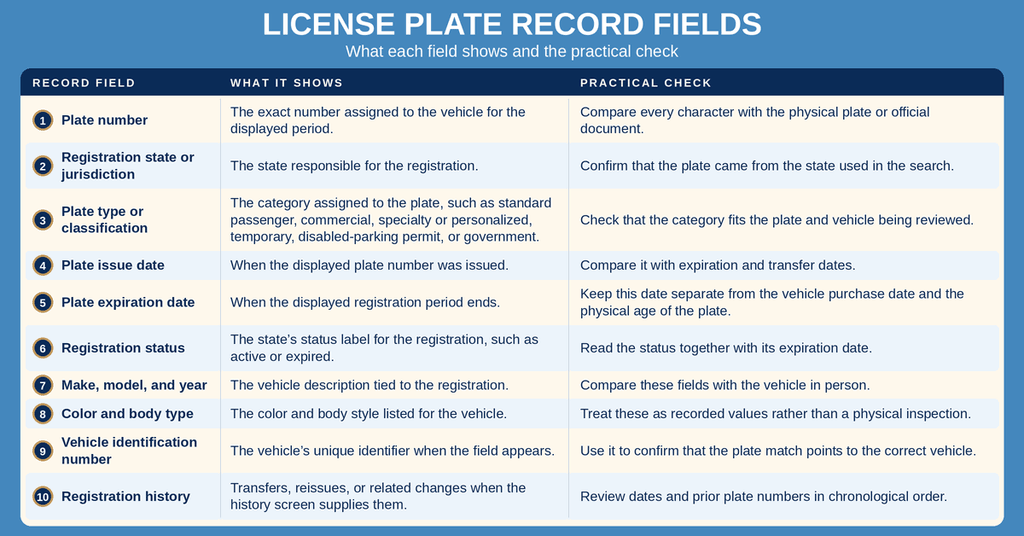
The Kansas Department of Revenue record can connect the plate with several parts of the same vehicle file. Some fields come from the title, some from registration, and some from plate history. A missing field should not be read as a negative fact; it may reflect the record type, privacy rules, or the date on which the file was updated.
Vehicle Make, Model, Year and Color
The make, model, year, color, and body type offer the quickest visual checks against a vehicle. Compare them with the vehicle itself and its official documents, rather than relying on a seller’s description alone. A mismatch can have a simple cause, such as a typo in the search, a reissued plate tied to a different vehicle, or an older recorded vehicle description. Confirm the plate number and vehicle identification number before drawing a conclusion.
Color and body type have special limits. The state file records what was entered for the vehicle, but it does not show the current paint condition or confirm a later body repair. Those checks require a physical viewing. The make, model, year, and plate number together usually provide a stronger match than one field by itself.
Registration Expiration and Status
Expiration date and status answer different questions. The expiration date gives the end of the registration period shown in the record. The status gives the state’s label at the time of the search. A plate can have an expiration date in the past and still match a vehicle that held a valid registration during that period.
A renewal, transfer, or reissue can change the record that appears now. Compare the issue date, expiration date, and status instead of treating an old expiration date as proof that the plate was never valid. A current registration may still carry the same plate number for years, so the issue date does not always mark the vehicle’s purchase date or most recent renewal.
Plate Classification and Issue Date
Plate classification tells what kind of registration the number represents. Kansas records can distinguish standard passenger plates from commercial, specialty or personalized, temporary, disabled-parking permit, and government categories. The exact category and field name shown depend on the plate and the record being viewed.
The plate issue date provides the starting point for that particular number. A newer issue date can point to a reissue, especially when an older number also appears in the history. Classification by itself does not show current registration status, so read it with the expiration date and status. A personalized message or specialty design may appear as part of the plate category, but the legal record still depends on the number and registration details.
Historical Plate Transfers and Reissues
A plate transfer and a plate reissue are different events. A transfer records a change in the registration or plate ownership. A reissue assigns a new plate number. Residents can also inspect marriage system for detailed public documentation. A historical view, when offered, can show prior numbers and actions tied to the vehicle or owner record. Use the issue date to place each entry in order and the vehicle identification number, when shown, to confirm that the entries belong to the same vehicle.
An old number may return an expired or transferred record. The current number may appear under a different registration period. That means a bare plate match cannot settle ownership by itself. Review the current and prior numbers, compare the dates, and use the official registration history when a transaction depends on the full sequence.
Privacy Rules and Owner Restrictions
License plate records have two layers: a public-facing vehicle and registration layer, and protected owner or driver data. A search can show one layer without showing the other. Kansas Department of Revenue rules and federal privacy law decide which fields may appear and who may request withheld records.
Public Vehicle Record Details
Public vehicle record details can include the plate number, registration state, plate type, issue and expiration dates, status, and basic vehicle description. These fields support vehicle and registration checks without naming a person. Public availability does not mean the whole file is open to anyone, and each field remains subject to the law that covers it.
A general web page or third-party summary cannot replace the state source when a formal decision depends on the result. The Kansas Department of Revenue remains the source for title and registration records. Third-party pages can help narrow a search, but their stored data may not match the current state record or the latest plate assignment.
Driver Privacy Protection Law
The federal Driver Privacy Protection Act, 18 U.S.C. §§ 2721–2725, limits the release and use of certain motor vehicle records. It permits release for purposes listed in the law or under an exception, and it limits certain uses even after a record is obtained. Kansas statutes and Division of Vehicles rules add state requirements. A plate number may lead to a searchable record, yet protected owner and driver details still require a permitted purpose and the correct request method.
The law applies to the type of data and the reason for the request, not merely to the person making it. An authorized request under one purpose should not be used for an unrelated purpose. Anyone handling owner or driver data obtained from the state should follow the use limits that apply to that data.
Restricted Personal Owner Files
Registered owner files may contain a name, home address, and links to driver-license data. General searches can limit or hide these fields. A request for them can require an approved legal reason, identity check, form, court order, or other proof listed by the agency. A missing owner field may mean privacy limits, a record kept by another office, or an incomplete public record. It does not by itself mean that the plate or vehicle is unregistered.
Protected files can also differ by request purpose. A person asking for their own record may use a different process from an insurer handling a claim or an agency handling a court matter. The public plate search should not be used to guess whether protected fields exist, and it should not be treated as a substitute for an authorized owner-record request.
Lawful Permissible Use Criteria
A lawful plate-record request states the reason for the request and fits a permitted purpose under the federal and Kansas rules. Common approved uses include:
- A vehicle owner seeking their own record, when the agency provides that service.
- A court case, police investigation, or approved government function carried out under the proper legal process.
- An insurance claim handled under the rules that apply to that use.
- A child-support agency acting through the proper legal process and with the required authority.
- A creditor, employer, rental-car company, towing business, or similar party acting within a listed permissible purpose and meeting the state’s conditions.
Ordinary curiosity, marketing, or a vague complaint does not meet the requirement on its own. A requester should use the official request route and supply any identity, authorization, or case reference the agency requests. If the purpose is unclear, ask the Titles and Registration office to state what documentation and legal basis apply before requesting protected fields.
Record Accuracy and Resolution
A missing license plate record has several possible causes, and the plate may be correct even when the first search fails. Start with the exact number, issuing state, and registration dates. Then decide whether the issue concerns data timing, a changed number, an expired registration, or a privacy limit. This order keeps a blank field from being treated as a false plate or false vehicle.
Confirming Format and Registration State
Read every character from the plate or official document. Letters such as O and zero can look alike, and a missing space can affect some search forms. You can also access birth online registry to review official records. Do not guess a character because one result seems close. The plate format belongs to the issuing state, so using the correct registration state matters even when the plate characters appear right.
Compare the entered number with the copy shown in the returned record. Search by plate and registration state rather than copying a generic example from another state. If the physical plate is damaged or missing, use the number printed on an official plate receipt, registration document, or title record.
Recently Issued or Transferred Plates
A newly issued plate or recent transfer can sit outside the online file until the new registration data reaches the state search. No fixed delay should be assumed because system timing can change with record volume and the type of transaction. A second search using the exact state and number can rule out a typing error, but it cannot replace official confirmation when a record remains missing.
If a filing deadline is close, contact the agency and keep a record of the attempt. Compare the plate issue date shown on the new plate or receipt with any earlier plate number found in the history. That comparison can show whether the search used a current number or an outdated one.
Expired, Reassigned, or Reissued Numbers
An expired result can be correct for the registration period shown. It can also represent an old plate number after a transfer or reissue. Compare the issue date, expiration date, status, and vehicle identifiers before using the result. A reassigned number may now match a different vehicle, so a bare plate match cannot settle ownership.
When the goal is to trace a number, review the historical entries or request the official registration history through the portal. Look for a transfer entry, a reissue entry, a different issue date, or a change in vehicle description. If none appears, the agency may need to review its source records because the public screen may contain only a limited history.
Restricted or Incomplete Records
Some incomplete results reflect restricted records rather than missing registration data. The portal may provide vehicle fields while withholding owner or driver fields. That result can confirm a plate-to-vehicle match, but it cannot serve as proof of the current owner, home address, title status, or lien status unless the agency supplies an authorized record.
If two official sources conflict, compare the title number, vehicle identification number, plate issue date, and expiration date. Then ask the Titles and Registration office to resolve the file. Screenshots and search dates can help keep track of what was checked, but they do not replace an agency-certified document.
Contact Information
Use the contact below for title and registration record questions that the official portal cannot resolve. The office handles Titles and Registration matters. Phone service follows the listed hours, with options selected as directed.
Frequently Asked Questions
Below are quick answers about searching Kansas license plates, what data you can expect, and common issues you may encounter.
How can I look up a Kansas license plate?
You can start a Kansas license plate lookup by visiting the Kansas Department of Revenue website and using the online search portal. Enter the full plate number exactly as it appears, then select the state of registration. The system matches the entry to its vehicle registration database and returns available details such as make, model, year, color, plate type, issue date, and current status. If you prefer phone assistance, call the Titles and Registration office at (785) 296‑3621 during business hours and follow the prompts for plate information.
What info appears in a Kansas plate search?
A Kansas plate search typically shows the vehicle’s make, model, year, body type, and color. It also lists the plate classification standard, commercial, specialty, or temporary plus the issue and expiration dates. The registration status (active, expired, or suspended) is displayed when available. Some records include the vehicle identification number (VIN) and any previous plate assignments, though owner names are not shown to the public. All data comes from the state’s motor vehicle registration file.
Can I find the vehicle owner from a plate?
Owner names are not part of the public license plate lookup in Kansas. The state protects personal information under privacy laws, so searches return only vehicle and registration details. Law enforcement or authorized agencies may access owner data for official purposes, but the general public must request a formal records request and meet specific criteria. If you need to verify ownership for a legal matter, consult an attorney or contact the Department of Revenue for guidance on the appropriate process.
Why might a plate not be found in the system?
A plate may fail to appear if the number was entered incorrectly, includes a typo, or uses the wrong state code. Plates that are newly issued, recently transferred, or have been retired may not yet be updated in the online database. Additionally, temporary or out‑of‑state plates sometimes require a separate lookup method. If the search still returns no result, call the Kansas Department of Revenue at (785) 296‑3621 for assistance and verify the exact plate format.
How do I check if a plate is active or expired?
After entering the plate number in the Kansas online portal, the result page lists the registration status. An “Active” label means the plate is currently valid, while “Expired” or “Suspended” indicates it is not in use. The display also shows the registration expiration date, allowing you to see when renewal is required. If the portal does not show status, you can call the Titles and Registration office during business hours and request the current registration condition for that plate number.